Student guide: Intercepts
A significant intercept is a stretch of a drillhole where the grade is worth reporting, written the way a company announces it:
6.0 m @ 5.56 ppm Au from 16.0 m
That reads: 6.0 metres down the hole, averaging 5.56 ppm gold, starting at 16.0 m depth. The Intercepts section of the Log tab finds them in the hole you are looking at, lists them under the log and shades them blue on that element’s column.
An intercept depends entirely on its rules. Change the cut-off or the dilution and the same assays give a different answer. That is why every report states its rules, and why this page goes through each one.
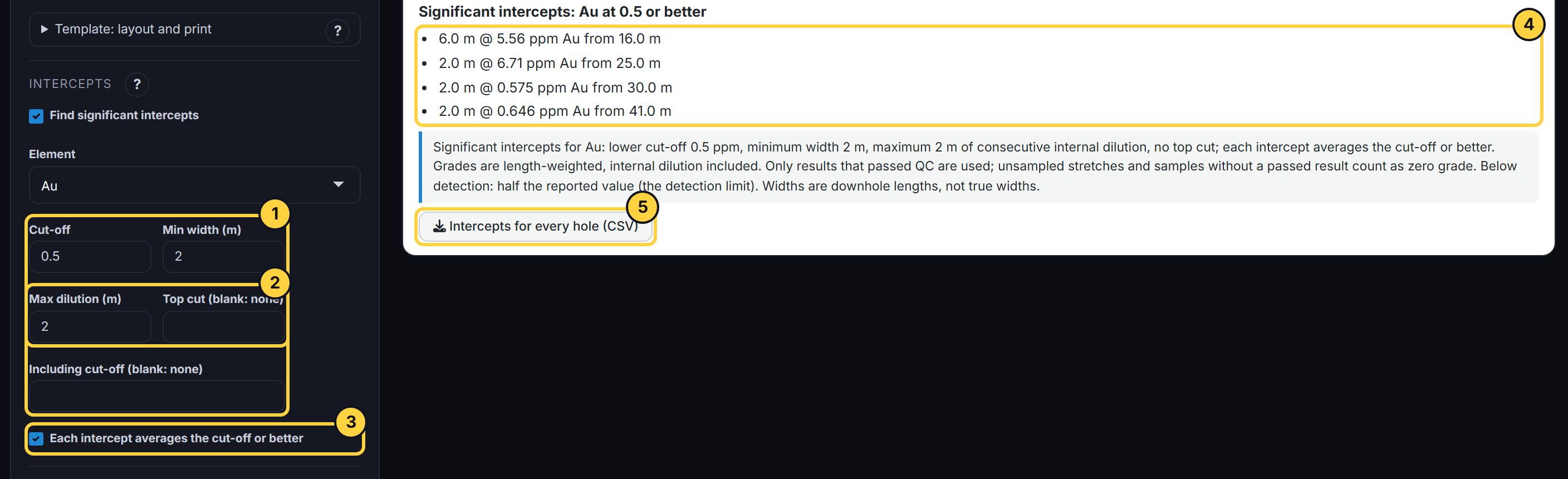
The controls
| Control | Default | What it does |
|---|---|---|
| Find significant intercepts | on | Turns the search on or off. |
| Element | the first assay chosen (Au) | The element to search on. |
| Cut-off | a usual value for the element | The lowest grade that counts as mineralised. Blank: no intercepts. |
| Min width (m) | 2 | The shortest intercept reported. |
| Max dilution (m) | 2 | The longest run of weaker samples allowed inside an intercept. |
| Top cut (blank: none) | none | High values are capped at this before averaging. |
| Including cut-off (blank: none) | none | A higher cut-off for the high-grade parts inside each intercept. |
| Each intercept averages the cut-off or better | on | Splits an intercept that dilution has pulled below the cut-off. |
When you change Element, the cut-off is set to a usual starting value: 0.5 for gold in ppm or g/t (500 in ppb), and 0.1 for copper in % (1000 in ppm). Other elements start at a high value of that element in the workbook (its 90th percentile).
How an intercept is built
The app walks down the hole, sample by sample, using the result shown on the log (see which result is shown).
- A sample at or above the cut-off starts an intercept, or extends the one already open.
- A sample below the cut-off is internal dilution. Its length is added to a running total of consecutive weak samples.
- When that run is longer than Max dilution, the intercept closes at its last sample above the cut-off. Weak samples after it are not included (trailing dilution is trimmed).
- The grade is the length-weighted average of every sample from the first to the last grade sample, dilution included: grade = Σ(length × value) / Σ length.
- Intercepts shorter than Min width are dropped.
Only results that passed QC count as grade. A sample whose only results are pending or failed, and a gap where nothing was sampled, count as zero grade: they are part of the interval but add nothing to it. The intercept says so: “(includes 1.0 m unsampled or without a passed result)”.
Why length-weighted: samples have different lengths. A 2 m sample at 10 ppm holds twice the metal of a 1 m sample at 10 ppm, so it must count twice as much.
A worked example
On hole J-000030 with the defaults (cut-off 0.5 ppm, min width 2 m, max dilution 2 m), the app finds:
- 6.0 m @ 5.56 ppm Au from 16.0 m
- 2.0 m @ 6.71 ppm Au from 25.0 m
- 2.0 m @ 0.575 ppm Au from 30.0 m
- 2.0 m @ 0.646 ppm Au from 41.0 m
Each line is one intercept. The note under them states the rules in words, ready for a report.
The rules, one at a time
Cut-off
The cut-off decides what counts as mineralised. A lower cut-off gives longer, lower-grade intercepts; a higher one gives shorter, richer ones.
Example: on J-000030 with a cut-off of 1 ppm instead of 0.5:
- 6.0 m @ 5.56 ppm Au from 16.0 m
- 2.0 m @ 6.71 ppm Au from 25.0 m
The two weaker intercepts, at 0.575 and 0.646 ppm, are below the new cut-off and disappear.
Max dilution
Max dilution is how much weaker rock you will carry inside an intercept, as a length. With 0 m, any weak sample ends the intercept. With more, weak samples between two rich ones are kept, and the intercept is longer but its grade lower.
Example: on J-000030:
| Max dilution | Intercepts |
|---|---|
| 0 m | 2.0 m @ 0.902 ppm from 16.0 m; 3.0 m @ 10.4 ppm from 19.0 m; and the three below |
| 2 m (default) | 6.0 m @ 5.56 ppm from 16.0 m; 2.0 m @ 6.71 ppm from 25.0 m; 2.0 m @ 0.575 ppm from 30.0 m; 2.0 m @ 0.646 ppm from 41.0 m |
| 4 m | 16.0 m @ 3.08 ppm from 16.0 m; 2.0 m @ 0.646 ppm from 41.0 m |
Why it matters: a mine can’t dig around every weak metre. Dilution reflects that some waste comes out with the ore.
Min width
Min width drops intercepts too short to matter. Example: with 4 m instead of 2 m, J-000030 gives:
- 6.0 m @ 5.56 ppm Au from 16.0 m
Only the 6 m intercept is long enough.
Each intercept averages the cut-off or better
With dilution allowed, a long run of weak samples can pull an intercept’s average below its own cut-off: an “intercept at 0.5 ppm or better” that averages 0.4 ppm. With this ticked (the default), such an intercept is split at its longest weak stretch, and the parts are checked again. Unticked gives the usual database report, which doesn’t split them.
Example: on J-000030, unticked: the list is the same, because none of its intercepts is pulled below 0.5 ppm by its dilution. The rule matters on holes with long, weak stretches between rich samples; try it with Max dilution at 4 m on J-000005.
Top cut
A top cut caps very high values before averaging, so one exceptional sample (a nugget of gold) doesn’t make a whole intercept look rich. The value is capped before it is compared with the cut-off, and the intercept says how many samples were capped.
Example: on J-000030 with a top cut of 5 ppm:
- 6.0 m @ 1.8 ppm Au from 16.0 m (1 top-cut)
- 2.0 m @ 3.24 ppm Au from 25.0 m (1 top-cut)
- 2.0 m @ 0.575 ppm Au from 30.0 m
- 2.0 m @ 0.646 ppm Au from 41.0 m
The first intercept falls from 5.56 to 1.8 ppm: one sample of 27.6 ppm carried most of its grade.
Including cut-off
An including cut-off, higher than the cut-off, reports the rich parts inside each intercept: “6.0 m @ 5.56 ppm Au from 16.0 m, including 2.0 m @ 12 ppm from 18.0 m”. These parts use no dilution, and a minimum width of 1 m (or the min width, if smaller). It must be above the cut-off; otherwise nothing is added.
Example: on J-000030 with an including cut-off of 5 ppm:
- 6.0 m @ 5.56 ppm Au from 16.0 m, including 1.0 m @ 27.6 ppm from 20.0 m
- 2.0 m @ 6.71 ppm Au from 25.0 m, including 1.0 m @ 11.9 ppm from 26.0 m
- 2.0 m @ 0.575 ppm Au from 30.0 m
- 2.0 m @ 0.646 ppm Au from 41.0 m
Below-detection results
The rule under Rules on the Log tab applies here too: a below-detection sample counts at half its stored value (normally the detection limit), or as written.
Every hole at once
Intercepts for every hole (CSV) runs the same rules on every hole in the workbook and downloads one table. With the defaults, the demo gives 28 intercepts in its 10 holes.
Each row has the hole, its project, collar (east, north, RL, grid), first survey (dip, azimuth) and depth, then the intercept: from, to, width, grade, gram-metres (width × grade), the number of samples, the metres of dilution, of gaps and of samples without a passed result, how many were top-cut, any including parts, and the text. If Report coordinates is set under Print, the collar in that coordinate set is added (REPORT_EAST, REPORT_NORTH, REPORT_RL, REPORT_GRIDNAME).
Gram-metres (width × grade) compare intercepts of different shapes: 2 m at 10 g/t (20 g·m) holds the same metal as 10 m at 2 g/t.
Widths are downhole lengths
Every width here is measured along the hole. If the hole crosses the mineralised zone at an angle, the zone’s true thickness is less. Reports say “downhole width” for that reason, and so does the note under the intercepts.
Exercises
- Cut-off and grade. On J-000030, record the intercepts at cut-offs of 0.3, 0.5 and 1 ppm. How do the total width and the highest grade change? Why does the grade go up as the width goes down?
- Dilution. Set Max dilution to 0, then 4 m. Which intercepts join or split? Which setting would a mine planner prefer, and which an explorer looking for a big target?
- The nugget effect. Find the highest Au value in J-000030 (hover on the column). Set a top cut just below it. How much does the intercept’s grade drop? What does that tell you about how much of the grade comes from one sample?
- Averaging the cut-off. Untick Each intercept averages the cut-off or better and compare the list. Is any intercept now below its own cut-off? Which list would you publish?
- Every hole. Download the CSV for every hole. Which hole has the most gram-metres? Is it the longest intercept or the richest?